
#1 The Question Behind Everything
Why do civilizations collapse? How much of human history is missing? How much of modern civilization do we misunderstand? What are we wrong about right now?

“History is a vast early warning system.”
Norman Cousins
“The farther backward you can look, the farther forward you are likely to see.”
Winston Churchill
“What is history but a fable agreed upon?”
Napoleon Bonaparte
Introduction: The Question Behind Everything
This blog introduces a project exploring a set of connected questions that I have gradually become obsessed with over the last decade.
Why do civilizations collapse?
How much of human history is missing?
How much of modern civilization do we misunderstand?
What are we wrong about right now?
You may consider these unrelated questions. And to be fair, I don’t blame you. After all, one concerns archaeology, one concerns history, one concerns modern society and one concerns the future.
But increasingly I have come to suspect they are all different aspects of the same underlying problem.
The problem is such: Human beings build systems far more complex than any human can understand. The average person has no conception of how a city feeds itself, how a currency holds its value, or how a supply chain crosses a dozen borders to put a phone in your hand. We all live inside these systems, we all depend on them pretty much entirely, and yet, for the most part, we understand practically none of them.
But this problem isn’t a new one. In fact, you could say it is the permanent condition of human civilization.
The Romans did not see the forces draining their currency and thinning their frontier. Medieval Europeans did not see the climate shift and the microbe that would gut their world. The people who built the Bronze Age palaces did not see how fragile the trade web was until it broke and took them with it. The Maya didn’t grasp how population growth affected their environment until their environment killed them. They were all roughly as clever as we are. They all were doing their best inside a world bigger than their grasp. They all failed anyway.
But here is the part that really interests me. Every one of these civilizations was sure it understood the world better than the ones before it. That confidence is one of the most reliable features of any society in history. It is also, again and again, wrong.
Look at the scale of our ignorance today (no offence). Modern humans have been around for at least three hundred thousand years. Writing, however, covers only the most recent five thousand. Thus, for more than ninety-eight percent of our time as a species, there is no text, no record, and no name to recover. Plus, the literate sliver is worse than it sounds. Only 1% of writings from the classical period (extremely recent in the human story) survive today. The other 99% burned, rotted, were lost or were copied until the last copy crumbled and no one made another. What reaches us is what happened to survive the gap between their world and ours. We do not inherit the past, we inherit its wreckage, and then we try desperately to reconstruct the rest.
So we know two things at once. Most of human experience is gone beyond recovery. And civilizations collapse, over and over, while certain they are stable. Their institutions miss the danger until it arrives and their elites mistake the familiar for the permanent. Afterwards, the warning signs look obvious, so we ask: how could anyone have missed them?
I think that’s the wrong question. They missed them for the same reason we miss ours. The assumptions that kill you are the ones too obvious to question, and our hindsight manufactures a fake clarity, one that nobody alive at the time could possibly have had.
Which leads me onto the real question.
It is not what happened in the past, though the past grips me. It is not what will happen next, which nobody knows. It is what we are failing to see right now. What do we assume so deeply we cannot even name it? What will our descendants find obvious about us that we cannot force ourselves to see?
That is the thread running through everything you’ll find me writing about in this blog. Lost history and archaeology, because they show how little of the human story we actually hold. Civilization and collapse, because they expose the recurring shapes of rise and fall. Institutions and technology, because they are the systems we are building now, mostly blind. Human nature, complexity, knowledge, uncertainty etc. because that is what it all comes down to in the end.
One inquiry covering topics that feel separate but aren’t. How civilizations emerge, grow, adapt, misread themselves, and sometimes vanish, taking most of what they knew with them.
Now I must be clear about what this is (and what it is not). It is not a source of answers. I do not have them, and I distrust anyone who says they do. It is an investigation. The aim is to ask sharper questions than the ones we usually settle for, and to follow them anywhere, including the uncomfortable places where our own confidence starts to look exactly like every confidence that came before it.
That is the work. Let’s begin.
The Great Silence
Let’s start by imagining a people who lived along a coastline twenty thousand years ago. A few thousand of them, spread across a stretch of shore, bound by a shared language and shared rules about who marries whom and how the dead are buried. They know how to read the sea, when the fish run, which plants heal and which kill, how to build a boat that survives open water. This knowledge took thousands of years to accumulate and lives entirely in memory and speech.
The culture lasts ten thousand years, far longer than the entirety of recorded history. But then the climate shifts, the sea rises, swallowing their shore, and they are gone. No descendants who remember them, no writing, and no stone. The knowledge of a hundred generations simply stops, and leaves nothing we can ever read.
It sounds sad really. But this is the ordinary fate of human societies for almost the entire span of our existence. Whole worlds of belief and knowledge, refined over timescales that dwarf the modern era, gone without trace because they were never written down and never built in anything that lasts.
Us modern types have a tendency to imagine the past as a trail of evidence that fades the further back you walk, but that is too kind. The record is a handful of disappearing footprints scattered across a desert, and from them we are trying to reconstruct the whole journey.
The reason is actually physics. Stone lasts but wood does not. Gold lasts yet cloth doesn’t. A dry cave or a waterlogged bog preserves what almost everywhere else rots within a mere generation. So the record we dig up is a sample of what people happened to make from durable material in a place that managed to stay undisturbed long enough for us to find it, not a sample of what they did. And that’s a big difference. A society that built in timber, stored its wealth in textile and kept its knowledge in song can vanish completely, while their neighbour who piled up some stone looks, to us, like the only civilization that ever stood there.
But the bias runs deeper than materials. For most of the human story the seas were lower, sometimes over a hundred metres lower, and the places people most wanted to live, the river mouths and sheltered coasts thick with fish, are now drowned offshore. If you set out to erase the bulk of human settlement, flooding every coastline would be an efficient method. And that is roughly what happened when the last ice age ended.
Now, you would expect the picture to sharpen as archaeology matures. Yet the strange thing is that it often does the opposite. Each major find tends to unsettle the story rather than settle it, and the corrections almost always run one way. They run backward. Whatever capacity we credited early humans with, the evidence keeps pushing the date earlier. Pigment and engraving and deliberate ornament, the marks of a mind that thinks in symbols, keep turning up far earlier than the textbooks allowed. People crossed open water to reach islands long before we thought possible, which perhaps means boats we have no surviving fragment of. Göbekli Tepe, arguably the most paradigm shifting site so far discovered, showed people raising monumental stone before agriculture, earlier than pottery, preceding the settled surplus that was supposed to be the precondition for any of it. No site has done more damage to the textbook sequence.
So the capability was always there ahead of where we had placed it. We just simply hadn’t found it yet.
Now, I want to be cautious, because this is the exact moment where careful thinking dissolves into seductive fantasy. None of this argues for a lost golden age or a vanished super-civilization. The honest claim is instead smaller (and more interesting). We have systematically underestimated early humans, through one repeated error: we read the absence of evidence as evidence of absence. No surviving boats meant no seafaring. No surviving symbols meant no symbolic mind. Then we looked harder (or got luckier) and the evidence was there, buried in the ground the whole time, waiting where we had assumed there was nothing.
This is the first reason the past is far less settled than it appears. The broad outline of recorded history is treated as fact, but the foundation beneath the deep past is much thinner than the confidence stacked on top of it. We are theorising about three hundred thousand years of human life (millions of years if you include other human species) from a few lucky caves and a few lucky artefacts, and for a long time we mistook the edge of the evidence for the edge of what was real.
So if we know this little about where we come from, how confident should we be about where we stand?
The Pattern
Move into the recorded past and a different problem appears. Here we have texts, names, dates, and incredible ruins we can excavate and cross-check. The silence lifts. And once you line up enough of the record, the thing that jumps out is repetition, rather than variety. Civilizations keep making versions of the same mistake, and keep being astonished when it costs them.
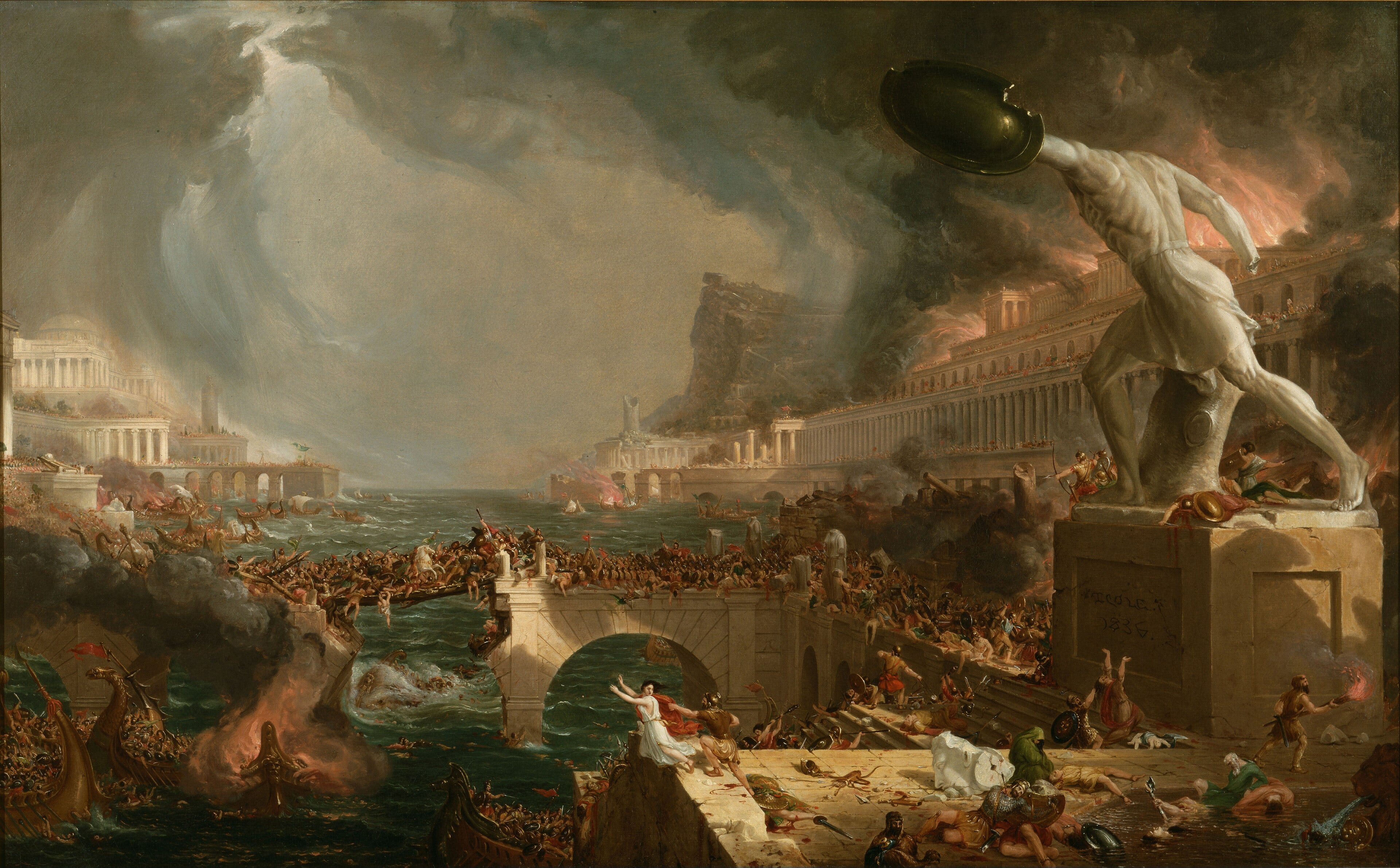
I’ll take the case everyone knows. Rome did not fall in an afternoon. It came apart across generations, while the people inside it carried on as if the arrangement were permanent. The coinage was debased a little at a time. The frontier thinned. The machinery that fed and defended the system degraded by increments too small to alarm anyone in a given year. There was no one morning when a Roman woke and suddenly understood ‘yeah, the world is ending’ because there almost never is. The structure rotted faster than the belief in the structure, and the belief held until there was nothing left underneath it.
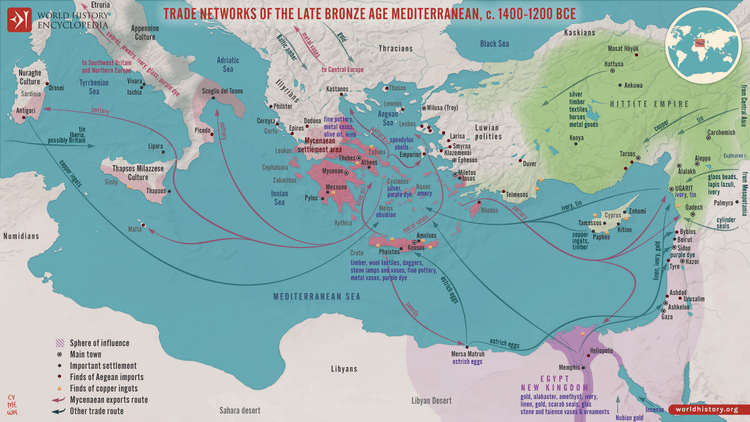
Go back further still and it turns even stranger, because it struck a whole interconnected world at once. Around 1200 BC the civilizations of the eastern Mediterranean, Mycenaean Greece, the Hittite empire and the great palace economies, were bound together by trade in a way that looks almost modern. Tin came from one source, copper from another, grain, metal and diplomacy all moving across the network. Then, inside roughly a single generation, most of it collapsed. Cities burned, the trade routes died, and some writing systems were lost so completely they have never been deciphered.
The web that made every part of that world rich was the web that ensured no part could survive the others failing. Today, we still argue about the trigger, but the lesson doesn’t depend whatever the cause may or may not have been. A system can be advanced and fragile at once, and sometimes the advancement is the fragility.
Cross an ocean and it happens again, with no possible contact between the cases. The Classic Maya built cities, astronomy, monumental architecture and a full writing system. Then the great southern centres were abandoned. The people walked away, over decades that they would have experienced as ordinary life slowly becoming unworkable. Drought on soil exhaustion, the strain of feeding elites and monuments from farmland that had stopped yielding more. A society optimised for the conditions it grew up in, meeting conditions that no longer matched, unable to change fast enough to keep up.
The detailed work on each of these belongs in later essays, and the causes genuinely differ from one to the next (which is part of the point). However, what I want to fix in place is narrower. The pattern is real, and it recurs across societies with no contact and nothing in common, not even the same continent. Rome and the Maya never knew the other existed. The Bronze Age palaces had no idea they belonged to a category. Yet the arc repeats: a society grows complex, comes to lean on arrangements it stops noticing, mistakes its own brief moment for the natural order of things, and then meets a change it has no structural capacity to absorb.
The modern instances are easy to find. Empires that seemed eternal within living memory are gone. Institutions built for a vanished world keep running on that world’s old assumptions long after it has disappeared. Financial systems discover their own fragility all at once, in events that look obvious in hindsight but were close to invisible beforehand. The details are new every time yet the shape is old, and it doesn’t care what century it is.
This is the second observation, and it sits in productive tension with the first. The deep past tells us how little we know. The recorded past tells us that the little we do know rhymes.
Which forces another uncomfortable question forward: If collapse recurs this reliably, and every collapsing society believed itself stable while it was happening, what exactly makes us the exception?
That is the question of this blog, and the one most writing about history quietly steps around.
Why This Matters Today
None of this would be more than a curiosity if the pattern stopped at the edge of the past. It does not. The same blindness that took down Rome and the Maya is a feature of being human inside a system too large to see whole, not a defect those people had and we have outgrown.
So the honest move is to turn the question on ourselves. What looks permanent to us right now that our grandchildren will find obviously doomed?
We are not better at this than the Romans were. Sure, we have more data, faster communication and better models. But we do not have any more capacity to question the assumptions we cannot see, and our systems are actually more interconnected and more fragile than theirs ever were. The warning signs of our own moment are almost certainly visible right now, sitting in plain view, unrecognised for the same reason theirs were: They look like normal life, not warnings.
That is the whole reason the past deserves this much attention. It trains you to spot the shape of a problem before it has a name.

Why I Became Interested In These Questions
I came to this slowly. I studied ancient history at university, and while the list of dates gripped me, it was the silences in the record, the sense that the textbook confidence rested on far less than it admitted, that truly got me hooked.
Later I worked in government, close enough to watch how institutions actually function. The thing that struck me was that intelligent, well-meaning people inside a large system routinely could not see what was obvious from outside it. It’s not that they were corrupt or stupid. The institution just had assumptions it could not examine, because examining them was nobody’s job and questioning them was everybody’s risk.
Eventually I started making videos about both, the deep past on one channel, the patterns of civilization on the other. And the longer I worked across the two, the more they stopped feeling like separate subjects. The questions kept rhyming. That recognition is what this blog grew out of.
What You'll Find Here
The essays here circle a set of questions rather than a syllabus of topics.
How sophisticated were people before history began, and how would we know? Why do complex societies keep collapsing, and is there anything common to how they go? What does a new archaeological discovery actually overturn, and what does it leave standing? Why do institutions fail to see the thing that ends them? What does it do to a civilization when it’s population stops growing? What should we make of a technology like AI, arriving faster than our capacity to understand it?
Lost history, collapse, institutions, demographics, technology, human nature. Different ideas, separate doors, but all leading into the same room. The unifying question is the one underneath: what does this teach us about what we are missing right now?
What You’ll Get Out Of It
Facts are cheap and everywhere so my aim is not to hand you facts. Actually, I want to inspire a shift in how you see.
You will start measuring the present against thousands of years instead of the last news cycle. Modern events begin to show their shape early once you have the long pattern in your head. And you get better at catching your own assumptions, which is the hard one, because they never feel like assumptions to yourself. You will also grow more comfortable sitting with uncertainty, which is the honest starting point for questions this large.
If that sounds useful, you are in the right place. If you want tidy answers and clean conclusions, I will probably frustrate you.
The Journey
A few honest warnings before we start.
We will not always agree, and I would be suspicious if we did. Many of the questions here have no settled answer, and I am not going to pretend otherwise to sound authoritative. Some of what I argue will turn out to be wrong, and when it does I would rather say so than defend it. Don’t mistake that for a weakness of the project because it is the project. An investigation is a sermon if it cannot be wrong.
Treat this as an exploration we are doing together, not a doctrine I am handing down.
Closing
So I come back to where I started, to the four questions underneath all of it.
Why do civilizations collapse? How much of human history is missing? How much of modern civilization do we misunderstand? What are we wrong about right now?
I do not have the answers. I am not sure anyone does. But after years spent studying the deep past and the recorded one, I have become convinced these are among the most important questions a person can ask, precisely because every civilization before us failed to ask them in time.
Let’s see how far we get.
Read the next essay here
#2 Why Every Civilization Thinks It's the Exception

“The difficulty lies, not in the new ideas, but in escaping from the old ones.”